


Five years ago, New Zealand’s then-Prime Minister Jacinda Ardern was famously criticized by Toyota for claiming an electric version of the Hilux was set to land in the “next 12 to 24 months”. It turns out Ardern wasn’t wrong about the electric Hilux coming to New Zealand, but her timeline was a little optimistic.
While Toyota is a brand known for its dominance in the hybrid space, this Hilux BEV is only the second pure electric vehicle it has launched in New Zealand. The BZ4X was the first, and now Toyota has used what it learnt from the electric SUV to create a Hilux that doesn’t require a drop of fuel to run.
The arrival of the BEV coincides with the launch of the ninth-generation Hilux and the 50th anniversary of the nameplate in New Zealand. Toyota hosted the event at its Palmerston North headquarters, where the electric model sat alongside the diesel and 48-volt mild hybrid variants that fill out a five-grade range. But it was the BEV that everyone had come to see.
A Hilux First, an EV Second
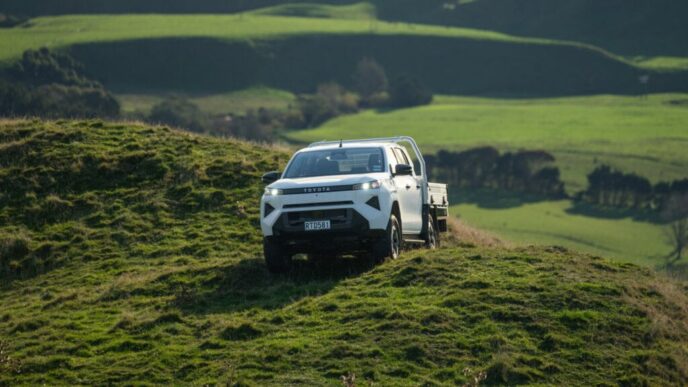
The Hilux BEV shares nothing with the diesel-powered Hilux on the powertrain front. It gets an electric motor on each axle to create an all-wheel drive system, in contrast to the part-time four-wheel drive setup in the diesel. It arrives in just two trims, SR and SR5, and double-cab only, available as either a cab chassis or with a wellside tub on the back.
Power comes from a 59.2kWh battery mounted between the chassis rails, feeding 144kW combined and around 400Nm of torque, with 200Nm from each motor. A peak charging figure hasn’t been confirmed, but Toyota claims a 10 to 80 per cent top-up in around 30 minutes.
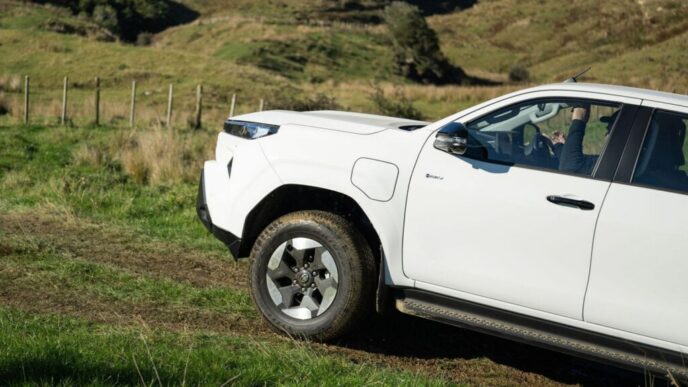
The battery provides a driving range of up to 315km for wellside models and 245km for the cab chassis variants. It’s worth noting both these figures are according to NEDC testing, meaning real-world range would likely be even lower.
Obviously that range figure is the elephant in the room, and you’d probably be lucky to achieve 300km in perfect real-world conditions. Towing takes a hit too, with the BEV rated to 750kg unbraked or 2,000kg braked, well down on the 3.5 tonnes offered by the diesel.
When speaking with Toyota New Zealand staff at the launch, I enquired about why a bigger battery wasn’t fitted, and the answer is simple. It’s a Hilux first and an EV second, so all the electrical driveline equipment had to be made to fit around the existing platform. That is extremely limiting when it comes to battery packaging, as Toyota wanted to retain the Hilux’s impressive off-roading abilities without compromising on battery safety.
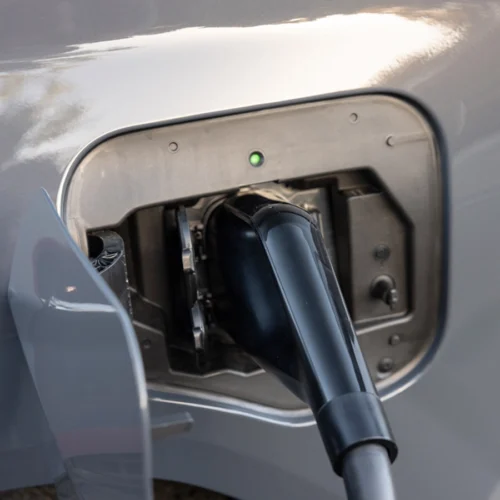
According to Toyota, larger batteries were looked into, but cracks in the casing during stress tests left them back in the parts bin. The result is a modestly sized 59.2kWh battery that has slotted between the chassis rails, sitting high enough to retain the same ground clearance as the diesel models, along with a 700mm wading depth.
A Bold New Face
The other big change with the new Hilux is far easier to spot. Dubbed ‘Cyber Sumo’, this new look sharpens the overall aesthetic and modernises it for the electric age.
The angular headlights bring a sense of attitude to the ute’s front fascia, and the grille looks to be positioned higher than previous models. The new look is also complemented well by the array of bumper and bull bar options on display at the launch, all offered as factory accessories.
As one of the biggest aesthetic updates the Hilux has experienced in a while, I’d go as far as to say this ‘Cyber Sumo’ look was centred around the new energy models. It suits the BEV perfectly with its shut-off grille between the headlights, and it would make sense to see the hydrogen-powered Hilux FCEV adopt the same fascia. I can imagine the executives at Toyota wanting a clear distinction between the old diesel-powered models and these new-age Hiluxes, hence the makeover.
Behind the Wheel
To kick off the launch, we arrived at a station just outside of Palmerston North. Toyota New Zealand is well aware most of its Hilux customer base is rural, so it was a fitting setting to get acquainted with the ninth-generation ute. After a familiarisation run in the diesel SR5 across an off-road course of climbs, descents, and a few water crossings, it was time to hit the track in the Hilux BEV.
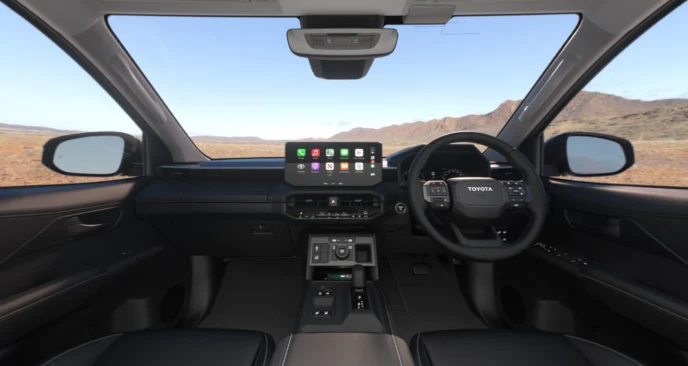
Straight away, despite sharing almost everything with the diesel variant, the BEV feels different. The gear selector is much smaller, and the dash display is unmistakably EV.
That theme continues as soon as we get going, as the Hilux BEV is eerily silent in its operation. There’s no clattering of a diesel engine, and the gravel crunch beneath the tyres is all you hear. With both motors working together, the BEV feels quicker at low speeds than the diesel variant. In saying this, the standard throttle response isn’t sharp, and it’s only once the ‘Sport’ drive mode is selected that you get an instant shot of torque you’d expect from an EV. Pair this with a gravel road, and I’m sure you’d find yourself having far more fun than anyone thought possible in a Hilux.
As well as being easier to drive normally, the Hilux BEV also proved more impressive than the diesel variant in the rough stuff. Where you’d normally have to select low range, choose a drive mode, and lock the diffs, the BEV makes things a lot easier with just a change in drive mode setting it up for questionable terrain. Once ‘Mogul’ mode was selected, which handles torque distribution between loaded and unloaded wheels, the BEV breezed up and down the obstacles with ease.
While the more reserved tuning of the throttle response is less exciting on the road, it means small inputs can be used across rough obstacles without getting any jerking like in low-range geared vehicles. There’s no denying the BEV is smoother during low-speed maneuvering.
Once we finished with the off-road stuff, we hit the road back to Palmerston North to see how the BEV performed at cruising speeds. Despite that impressive low-speed acceleration, the BEV doesn’t carry the momentum all the way to 100km/h. I’d estimate it slows around the 60km/h mark, and I’m pretty confident in saying it is slower to 100km/h than its diesel-powered counterpart. This will be something I’d be interested in testing once we get our hands on the new Hilux down the track.
The Price Question
Toyota New Zealand has now confirmed pricing for the Hilux BEV, and it has landed at the upper end of expectations. The range opens with the SR Double Cab Chassis at $79,990, though that figure does not include a tray. The SR Double Cab Ute follows at $81,990, and the SR5 Double Cab Ute tops the line-up at $85,990.
For context, the diesel-powered Hilux ranges from $49,990 to $63,990, while the closest diesel hybrid comparisons, the SR Hybrid 4WD Double Cab Wellside and SR5 Hybrid 4WD Double Cab Wellside, sit at $56,990 and $60,990 driveaway respectively. That puts the BEV premium at more than $20,000, or roughly 40 per cent, over an equivalent diesel hybrid.
It confirms that New Zealand’s vastly different framework around emissions makes for very different maths, with the BEV commanding a hefty premium over its combustion counterparts.
Pre-orders open towards the end of May, with two colours offered, Glacier White and Ash.
The Verdict
I can imagine the Hilux BEV being a hit with large commercial operations looking to reduce their carbon footprints and running costs. And anyone that can utilise the BEV in their operation will benefit from a Hilux that’s very easy to live with.
I would go as far as to say the Hilux BEV is the best Hilux on offer, but that comes with the caveat of the battery not being big enough for the majority of use cases. If Toyota is able to package a bigger battery into it, or fit a solid state battery, and increase the real-world range to 400km plus, they will be on to an absolute winner.
But they are in a race against a bunch of Chinese brands looking to enter the market with their electric and hybridised utes, which will likely land at a lower price point. That will force consumers to pick between the cost-effective retail option, or the tried and tested Hilux.


